On November 25, 2026, the FCC gave SpaceX conditional approval for something that sounds like science fiction: up to one million satellites working as orbital data centers. The plan calls for the first satellite by 2033, 100,000 by 2035, 500,000 by 2038, and the full million by 2040. But undersea data centers may get there first. SpaceX calls the system Starmind, and the approval is conditional: nothing above 600 km until SpaceX files a final debris plan.
I spent about thirty years around fiber networks and colocation data centers, and I’ll say it plainly: this is bold, and I’m rooting for it. AI needs enormous amounts of power and cooling, and Elon Musk is right that we have to look beyond the usual places to build.
But there’s another frontier that can carry AI compute today, while orbit grows up. It’s under the ocean.
The Cost Gap
An analysis by SemiAnalysis put orbital compute at about $8.64 per GPU-hour, compared with about $2.37 on the ground. That’s roughly four times the cost. Their estimate is that space doesn’t reach cost parity until around 2040. A big reason is launch: getting the hardware up there is more than half the up-front cost.
Launch costs will keep falling. SpaceX has proven that again and again. But for the next decade or so, every server in orbit costs a lot more than one closer to home.
What Undersea Data Centers Already Proved
Microsoft tested this with Project Natick, sinking a sealed data center pod on the seabed off Scotland. The results were remarkable. The pod ran at a PUE of 1.07, which means almost every watt went into computing instead of cooling. And its servers failed at about one-eighth the rate of the same servers on land.
Why? Cold, steady seawater does the cooling for free. The pod was sealed with dry nitrogen, so no humidity, no oxygen corrosion, and no people bumping into racks. Microsoft eventually wrapped up the experiment, but it proved the idea works.
You Can Pull It Up and Fix It
Here’s the point that matters most to me. When a seabed pod has a problem, a crew can haul it up, repair it, and drop it back down.
In orbit, the hazards are different. Cosmic rays flip bits and wear chips out over time. A micrometeorite traveling miles per second can punch right through a satellite. And when a satellite fails, there’s no service call. It’s just lost. None of those things happen a few hundred feet under the ocean.
Space AND Sea
This doesn’t have to be a contest. Orbit is a long-term bet that could pay off in a big way. The ocean is the near-term answer: cheaper, closer to the people who use the data, and fixable when something breaks.
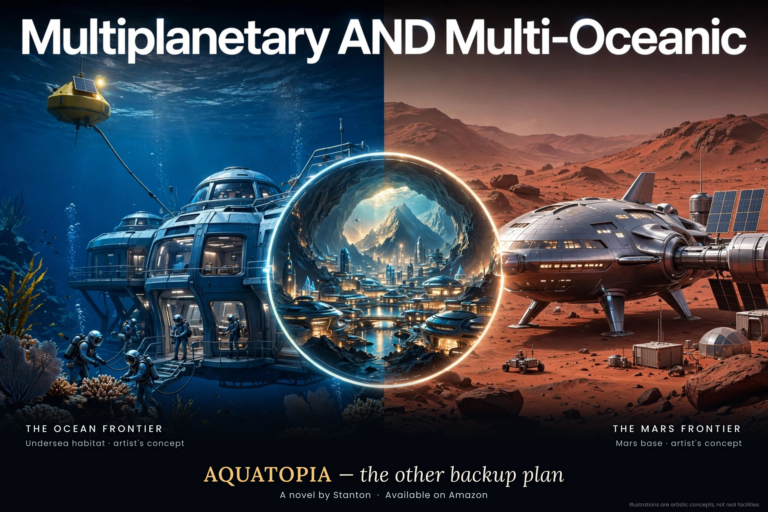
Groups like the Atlantis Sea Colony are already designing what life and work under the sea could look like. And if you want to see where that idea could lead, it’s the world I wrote about in my novel Aquatopia: a city inside an undersea mountain, nine hundred feet down.
Jules Verne sent the Nautilus under the sea more than 150 years ago. Maybe it’s time we followed.
Search “Aquatopia by Stanton” on Amazon.